AI Sales
September 23, 2026
22 min read



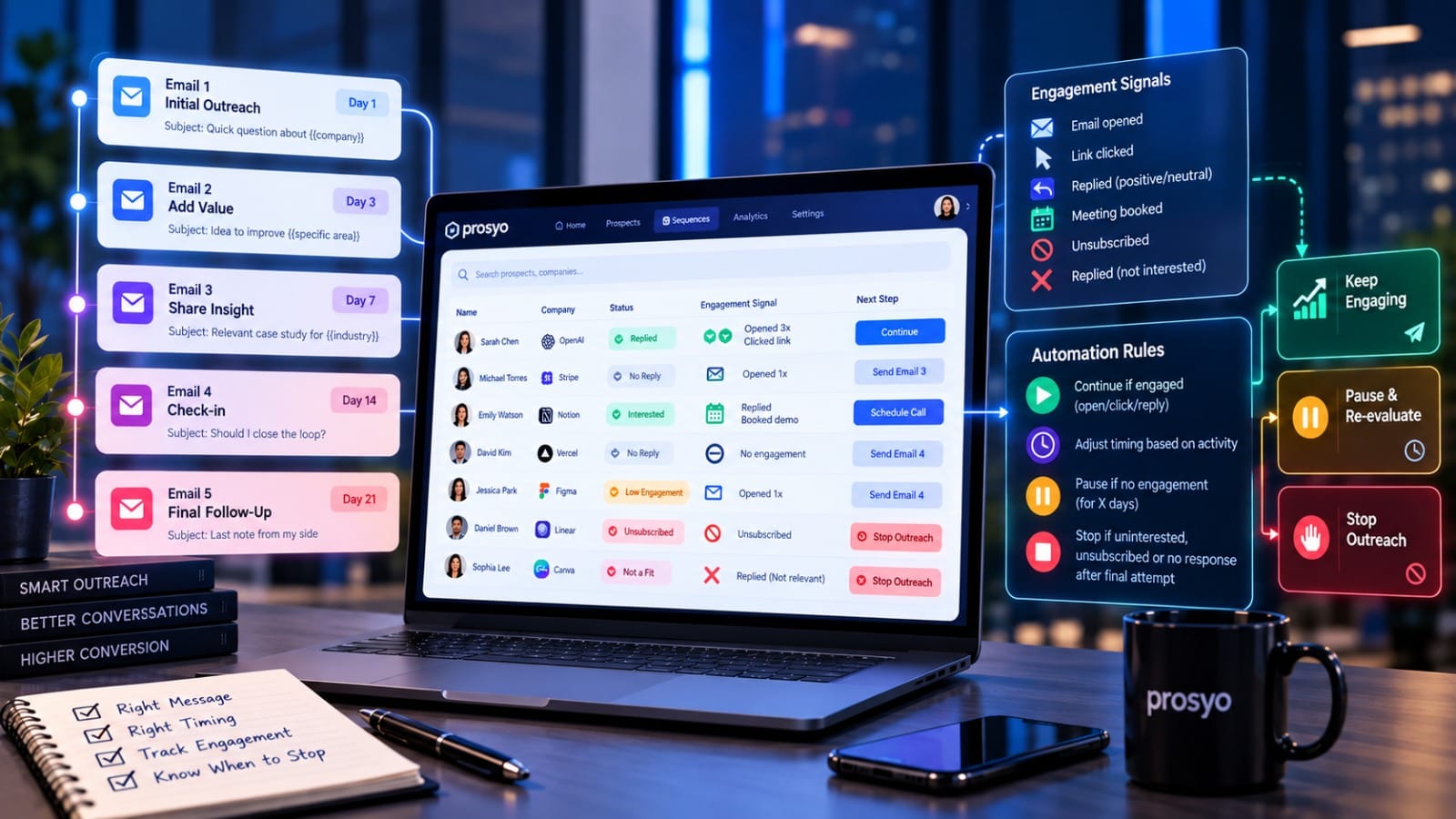
B2B outbound follow-up is one of the most important parts of turning cold prospects into sales conversations. But there is a common problem: sales teams often do not know when to follow up again and when to stop.
Follow up too little, and you may lose a prospect who was genuinely interested but busy. Follow up too much, and your messages can become repetitive, irrelevant, or unwanted.
The answer is not simply to send more messages. Effective B2B lead nurturing depends on timing, relevance, prospect behavior, and knowing when there is no longer enough engagement to justify another touch.
B2B outbound follow-up is the process of contacting a prospect after the initial outreach through channels such as email or LinkedIn.
The purpose is to continue a relevant business conversation, not repeatedly ask the prospect to buy.
A useful outbound sales follow-up should give the prospect a reason to respond, such as:
Prosyo supports LinkedIn and email sequences, personalized messaging, prospect context, engagement activity, replies, and pipeline management in one outbound workflow.
The short answer is: stop the active follow-up sequence when repeated, relevant attempts produce no meaningful engagement and there is no new buying signal or business reason to continue.
That does not necessarily mean permanently removing the prospect.
Instead, move the prospect from active outbound follow-up into a suitable nurture or re-engagement process.
The key distinction is between chasing and nurturing.
Chasing means repeatedly sending similar messages without new context.
B2B lead nurturing means staying relevant and giving the prospect a reason to re-engage when the timing becomes better.
If a prospect has received several well-timed and relevant messages but has not replied or shown meaningful engagement, continuing the same sequence may have diminishing value.
Review:
Do not judge a prospect only by the number of messages sent. The quality and relevance of those messages matter.
A direct rejection should normally end the active sales sequence.
If someone says they are not interested, continuing to send automated sales messages can damage the relationship.
Instead, record the response and determine whether there is a legitimate future reason to reconnect.
Not every prospect should remain in your outbound campaign.
Consider stopping when the prospect does not match your ICP, has no relevant business problem, is outside your target market, or does not have the appropriate role or buying relevance.
Better targeting can prevent sales teams from wasting time following up with unsuitable prospects.
Prosyo allows teams to prospect around ICP, target accounts, industries, titles, markets, and buying signals before outreach begins.
A follow-up should ideally add something new.
If every message simply says “just checking in” or “following up again,” the prospect has little reason to respond.
A new trigger could include:
Without new context, consider ending the active sequence.
The difference between chasing and nurturing is mainly about relevance and timing.
| Chasing a Prospect | B2B Lead Nurturing |
|---|---|
| Repeats similar messages | Adds relevant context |
| Focuses mainly on getting a reply | Focuses on building future relevance |
| Uses fixed follow-ups without context | Responds to prospect behavior |
| Continues despite clear disinterest | Respects negative responses |
| Measures activity | Looks at engagement and pipeline |
| Treats every prospect similarly | Uses prospect and company context |
The goal of outbound sales follow-up should be to create useful opportunities for conversation rather than maximize the number of messages sent.
Before creating a follow-up sequence, establish who should receive it.
Define:
A clear ICP makes follow-up more focused.
Personalization should go beyond adding a prospect’s first name.
Use relevant information about the prospect, company, role, industry, or business context.
Prosyo uses prospect, company, and campaign context for behavior-based personalization rather than relying only on generic templates.
A B2B outbound follow-up strategy can combine LinkedIn and email rather than treating each channel as an isolated campaign.
For example:
Prosyo supports coordinated LinkedIn and email sequences, including connection requests, LinkedIn messages, email touches, follow-ups, timing, and conditions.
Do not treat every prospect the same after the first message.
Monitor available signals such as:
Behavior-based information can help determine whether a prospect should continue in an active sequence or move into nurture.
Every outbound campaign should have a clear stopping condition.
For example, stop active outreach when:
The exact number of touches should depend on your audience, channel, offer, and sales cycle rather than using one universal number.
Prosyo is an AI-powered outbound platform built around prospect discovery, personalization, multichannel outreach, replies, and pipeline visibility.
It brings prospecting, enrichment, intent, AI personalization, LinkedIn and email outreach, replies, and analytics into one connected outbound system.
Teams can use Prosyo to:
Prosyo also emphasizes human control, allowing teams to review important targeting, copy, and campaign decisions before outbound communication represents their brand.
There is no universal number that works for every B2B campaign. The appropriate number depends on the prospect, sales cycle, offer, channel, and engagement. A better approach is to define a sequence with clear stopping conditions rather than following up indefinitely.
If multiple relevant attempts produce no meaningful engagement, consider stopping the active sequence and moving the prospect into a longer-term nurture process.
Follow-up is usually focused on continuing an active sales conversation. Lead nurturing keeps a prospect connected over time with relevant information until there is a stronger reason for a sales conversation.
Avoid simply asking whether the prospect saw your previous message. Add useful context, address a relevant problem, share a useful insight, or explain why the conversation may be relevant to their current situation.
Yes. A coordinated LinkedIn and email strategy can provide multiple relevant touchpoints instead of relying on a single communication channel.
Do not necessarily discard them. If they are still a good fit, move them from active sales follow-up into an appropriate B2B lead nurturing or re-engagement process.
The biggest B2B outbound follow-up mistake is assuming that more messages automatically create more sales conversations.
Effective outbound sales follow-up requires relevance, timing, personalization, and clear stopping rules. Sales teams should know when to continue, when to change the message, when to move a prospect into nurture, and when to stop contacting them.
A modern outbound workflow can make this process easier by connecting prospect research, personalization, LinkedIn, email, engagement, replies, and pipeline management.
Prosyo brings these activities together in one connected outbound system, with AI-powered workflows available through its platform as well as ChatGPT and Claude through MCP.
The objective is simple: do not chase prospects indefinitely. Use relevant context, pay attention to behavior, create meaningful follow-up opportunities, and know when the right next step is to stop active outreach and wait for a better reason to reconnect.