Marketing Automation
September 16, 2026
10 min read


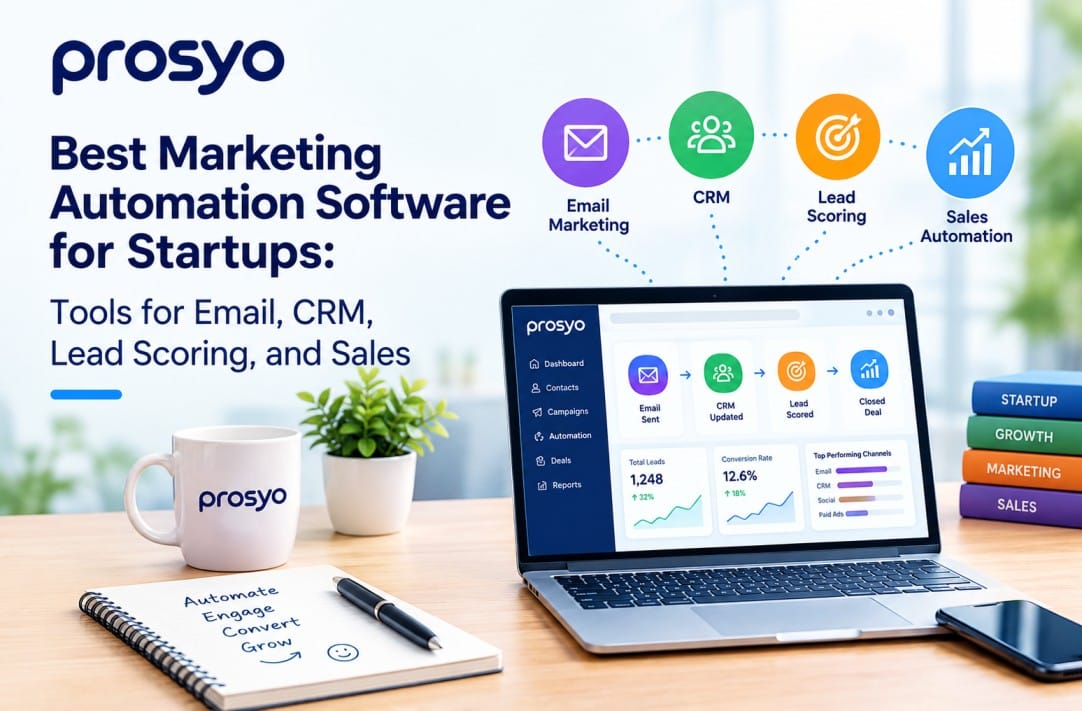
Startups need to attract leads, build relationships, and convert prospects into customers. However, managing emails, follow-ups, customer data, and sales activities manually can consume valuable time. This is where marketing automation software helps.
The best marketing automation software enables startups to automate repetitive marketing and sales tasks, organize customer information, score leads, and improve conversions. From email marketing automation software to CRM automation and automated sales follow-ups, the right platform can help a small team work more efficiently.
In this guide, we explain what marketing automation software is, which features startups should look for, how different tools compare, and how to choose the right solution for your business.
Marketing automation software is a platform that uses workflows, rules, and triggers to automate marketing activities. These activities may include sending emails, nurturing leads, tracking customer interactions, assigning lead scores, and notifying sales teams when a prospect is ready to buy.
For example, when someone downloads an ebook from a startup’s website, marketing automation can automatically send a welcome email, add the person to a lead-nurturing campaign, update their CRM profile, and notify the sales team after the lead shows strong buying intent.
Marketing automation connects marketing and sales automation so businesses can manage the customer journey from the first interaction to conversion.
Most automation systems follow a simple process:
This process helps startups reduce manual work while maintaining consistent communication with potential customers.
Startups often operate with limited budgets, small teams, and ambitious growth targets. Manual marketing processes can create delays, missed follow-ups, and inconsistent customer experiences.
The best marketing automation software helps solve these challenges by bringing marketing, customer data, and sales processes into one connected system.
For startups, automation is not only about sending emails automatically. It is about creating a repeatable process that moves prospects through the buying journey.
The right platform depends on a startup’s budget, business model, sales process, and technical requirements. Some tools focus on email marketing, while others combine CRM, lead scoring, customer journeys, and sales automation.
Below are some widely considered options for different startup needs.
HubSpot Marketing Hub combines marketing automation, CRM, lead management, analytics, and sales integration in one ecosystem. It is suitable for startups that want to connect marketing and sales activities.
Key features include:
HubSpot can be useful for startups that expect their marketing and sales operations to become more sophisticated over time. However, startups should review its pricing and available features carefully as their requirements grow.
ActiveCampaign is known for email marketing automation, customer journeys, and CRM-related automation. It is often considered by startups that want to create personalized campaigns based on customer behavior.
Key features include:
It can be a strong option for startups focused on email engagement and automated follow-ups.
Brevo offers email marketing, automation, customer relationship management, and communication features. It may suit startups looking for a platform that supports email campaigns and customer communication without requiring a highly complex setup.
Key features include:
Brevo can be considered by startups that want to begin with email automation and expand their communication processes gradually.
Mailchimp is widely recognized as an email marketing platform that also provides automation, audience management, and campaign analytics. It may be suitable for early-stage startups that primarily need email marketing automation software.
Key features include:
Mailchimp is often a practical starting point for startups building newsletters, onboarding campaigns, and promotional email sequences. Businesses should compare the features available in each plan before selecting it.
Zoho Marketing Automation is designed to support lead generation, customer journeys, website tracking, and marketing automation. It may be useful for startups that already use other Zoho applications or want a connected business software ecosystem.
Key features include:
It can be a suitable option for startups that want to connect marketing activity with broader business operations.
Klaviyo is particularly well known for ecommerce marketing automation and customer communication. It focuses on personalized email and SMS campaigns based on customer behavior and purchase data.
Key features include:
For ecommerce startups, Klaviyo may be more relevant than a general-purpose marketing automation platform.
The following comparison provides a general overview. Features, pricing, and plan limitations can change, so startups should verify current details on each provider’s official website before making a purchase.
| Software | Best For | Key Automation Features | Suitable Startup Use Case |
|---|---|---|---|
| HubSpot Marketing Hub | All-in-one marketing and sales | CRM workflows, email automation, lead nurturing, analytics | Startups building integrated marketing and sales operations |
| ActiveCampaign | Advanced email automation | Behavioral triggers, customer journeys, CRM automation | Startups focused on personalized lead nurturing |
| Brevo | Email and customer communication | Email workflows, contact management, transactional email | Startups beginning with affordable communication automation |
| Mailchimp | Email marketing | Automated campaigns, audience segmentation, email journeys | Early-stage startups focused on newsletters and email campaigns |
| Zoho Marketing Automation | Connected business ecosystem | Lead tracking, website tracking, customer journeys | Startups using or considering Zoho business tools |
| Klaviyo | Ecommerce automation | Abandoned cart, segmentation, product-based campaigns | Ecommerce startups focused on customer retention and revenue |
Choosing software based only on popularity or price can lead to poor results. Startups should focus on features that match their current workflow and future growth plans.
Email automation allows businesses to send relevant messages based on customer actions or predefined schedules.
Useful capabilities include:
Good email marketing automation software should make it easy to create workflows without requiring advanced technical knowledge.
CRM integration connects marketing activity with customer and sales data. It helps teams understand which pages a prospect visited, which emails they opened, and where they are in the sales pipeline.
A connected CRM can help startups:
Lead scoring assigns points to prospects based on their characteristics and behavior. For example, a visitor who downloads a pricing guide, visits a product page, and requests a demo may receive a higher score than someone who only reads a blog post.
Lead scoring can consider:
A well-designed lead scoring model helps sales teams focus on prospects who are more likely to convert.
Marketing and sales automation can reduce delays between lead generation and sales follow-up.
Common sales automation features include:
Startups should ensure that automation supports the sales team’s process instead of creating unnecessary complexity.
Automation is only valuable when businesses can measure its performance. Look for reporting features that track:
These insights help startups identify what works and improve their marketing strategy.
Selecting a platform becomes easier when you evaluate it against your business goals rather than choosing based on features alone.
Determine what you want to automate first. Your primary challenge may be email follow-ups, lead management, customer onboarding, or sales coordination.
Start with one or two high-impact processes instead of automating everything immediately.
Compare subscription costs, contact limits, email volume, user seats, and additional charges. A low starting price may increase as your contact database and automation requirements grow.
Choose software that fits both your current budget and expected growth.
Make sure the platform integrates with the tools your startup already uses, such as:
Strong integrations reduce manual data transfer and improve workflow reliability.
A platform with hundreds of features is not always the best choice. Request a demo or use a free trial to check whether your team can create campaigns, build workflows, and understand reports easily.
Choose a platform that can support your startup as it grows. Consider whether it can handle more contacts, additional users, advanced segmentation, multiple sales pipelines, and more complex customer journeys.
Track performance before and after automation. Review metrics such as lead response time, conversion rate, email engagement, and sales-qualified leads.
Use these results to improve workflows and remove unnecessary steps.
Marketing automation works best when it supports a clear customer experience. Follow these best practices:
Automation should make communication more relevant, not make customers feel like they are receiving generic messages.
Startups need more than software. They need a clear strategy for attracting the right audience, nurturing leads, and converting opportunities into customers.
Prosyo can help businesses evaluate their marketing processes, identify repetitive tasks, and build an automation strategy aligned with their growth goals. This may include improving lead capture, connecting CRM systems, creating email nurturing workflows, and supporting marketing and sales coordination.
The right approach is to begin with measurable business objectives and then select the technology that supports those objectives.
The best marketing automation software depends on the startup’s needs. HubSpot may suit businesses seeking an integrated marketing and sales platform, while ActiveCampaign may be useful for advanced email automation. Mailchimp and Brevo may suit startups beginning with email campaigns.
Yes. Marketing automation can help small startups save time, improve follow-ups, nurture leads, and manage customer communication more consistently. The key is to start with simple, high-value workflows.
CRM software manages customer information, sales activities, and relationships. Marketing automation focuses on automating marketing tasks such as email campaigns, lead nurturing, segmentation, and customer journeys. Many modern platforms combine both capabilities.
Marketing automation can improve lead conversion by delivering timely follow-ups, nurturing prospects with relevant content, and helping sales teams prioritize qualified leads. Results depend on the quality of the strategy, content, data, and sales process.
Startups should generally prioritize email automation, CRM integration, lead capture, segmentation, lead scoring, analytics, and ease of use. These features create a strong foundation before more advanced automation is introduced.
The best marketing automation software for startups is not necessarily the platform with the largest feature list. It is the solution that helps your team solve real marketing and sales challenges while remaining affordable, easy to use, and scalable.
Whether you need email marketing automation software, CRM integration, lead scoring, or automated sales follow-ups, the right platform can improve efficiency and create a more consistent customer journey.
Start by identifying your biggest bottleneck, compare the available tools, and implement a few focused workflows. With the right strategy and support from a partner such as Prosyo, startups can turn marketing automation into a reliable engine for sustainable growth.