B2B Prospecting
September 24, 2026
8 min read



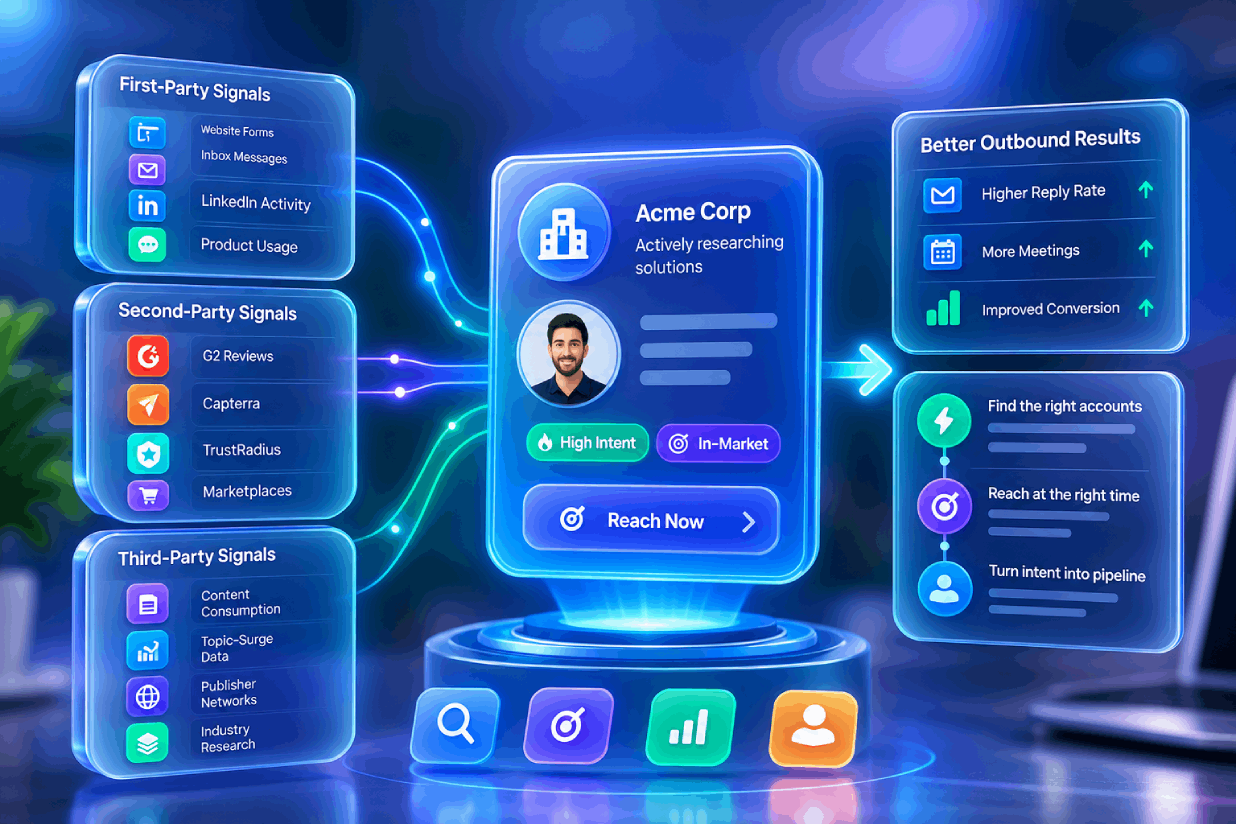
Buyer intent data is evidence that a person or company is actively looking for a solution. It comes in three grades. First-party signals come from your own website, inbox and social presence — someone fills in a form, messages you, or asks publicly for a recommendation. Second-party signals come from review and marketplace sites where buyers compare vendors. Third-party signals are inferred from content consumption across publisher networks and tell you a company is researching a topic, not who at that company is doing it.
Most teams buy third-party data and ignore the first-party signals sitting unread in their own LinkedIn inbox. That is backwards. First-party signals convert several times better because they identify a person, they carry that person’s own words, and they are free.
The outbound playbook that built the last decade of B2B was volumetric. Buy a list, write a sequence, send it to ten thousand people, accept a 1% reply rate, hire another SDR when you need more pipeline. It worked because inboxes were less crowded and because the maths, while ugly, closed.
Three things broke it.
The channels got capped. LinkedIn tightened invitation limits to the point where volume is no longer a strategy available to you — around 100 invitations a week per account is the practical ceiling, as we cover in detail in our guide to LinkedIn automation safety and limits. Email got capped from the other direction when Google, Yahoo and Microsoft imposed bulk sender requirements with a hard spam-complaint ceiling of 0.3%. You can no longer buy your way out of a bad list with more sending.
The copy stopped differentiating. When every seller has access to the same AI writing tools, “personalised at scale” collapses into a genre. A buyer can spot a generated first line in half a second, because they got four of them this morning. Merge fields are not personalisation; they are punctuation. We argued this at length in why cold email personalisation is broken.
The buyer moved first. This is the part most teams still miss. B2B buyers now do their research in public — they ask for recommendations on LinkedIn, they post about the problem, they comment under a competitor’s announcement, they read your pricing page twice on a Tuesday. By the time a seller’s cold sequence reaches them, they have usually already shortlisted.
Intent-led outbound is the response. Instead of picking a list and hoping some fraction of it is in-market, you watch for the moment someone enters the market and reach them then. The volume goes down. The acceptance rate, the reply rate and the meeting rate all go up.
| First-party | Second-party | Third-party | |
|---|---|---|---|
| Where it comes from | Your website, your inbox, your LinkedIn, your product | Review sites and marketplaces — G2, Capterra, TrustRadius | Publisher networks tracking content consumption across the web |
| Resolves to | A named person, usually | A company, sometimes a person | A company, almost never a person |
| Evidence type | Observed. They did the thing. | Observed on someone else’s property. | Inferred from a topic-surge model. |
| Latency | Minutes to hours | Days | Days to weeks |
| Typical cost | Free — you already own it | $$ — intent products on G2 and similar | $$$ — Bombora and resellers |
| Best for | Knowing who to message today | Competitive displacement | Account prioritisation for enterprise ABM |
| Main weakness | Volume is limited by your own reach | Expensive, narrow, category-dependent | You know a company is researching — not who, and not what they will do |
Enterprise sales teams have spent a decade buying the right-hand column. For a company with a named-account list of 500 enterprises and a six-person SDR pod, third-party intent genuinely helps decide which fifty accounts to work this quarter.
For almost everyone else — founders, small sales teams, agencies, consultants — the left-hand column is dramatically better value and almost entirely untapped. You do not need to know that “an unnamed person at Acme Corp read three articles about outbound tooling”. You need to know that Adrian, Head of Sales at Acme, posted yesterday asking which LinkedIn tool people recommend.
Not all signals are equal. Below is the full set worth collecting, graded by strength. Strength here means: how likely is a well-written message to this person, today, to get a reply.
| Signal | Why it is strong | Where you find it |
|---|---|---|
| Public request for a recommendation | They named the problem and asked for vendors. The highest-converting signal in B2B, full stop. | LinkedIn post search |
| Comment on someone else’s request asking for the same thing | Identical intent, one degree removed. Almost nobody works these. | Comments on Tier-1 posts |
| They messaged you first | Inbound. Treat as a lead, not a prospect. | Your LinkedIn inbox |
| Connection request with a note mentioning your space | They came to you with context. | Your pending invitations |
| Form fill, demo request or sign-up | Self-identified. Note: anyone can type anything into a form, so verify before automating. | Your website |
| Signal | Why it is strong | Where you find it |
|---|---|---|
| Repeat visits to your pricing or booking page | Pricing is a late-funnel page. Two visits in a week is a shortlist. | Website analytics / visitor identification |
| Commented on a competitor’s post or announcement | They are in the category and engaged enough to type. | |
| Engaged with your content more than once | Repetition separates interest from a scroll. | Your posts |
| Opened and clicked a link you sent, then kept reading | Campaign activity, not cold intent — but it changes what you say next. | Your sequences |
| Asked a question in a relevant community or group | Problem-aware, vendor-agnostic. | LinkedIn groups, Slack communities, subreddits |
| Signal | Why it works | Where you find it |
|---|---|---|
| New decision-maker started in a relevant role | First 90 days is when budget gets re-cut and vendors get replaced. | LinkedIn job-change tracking |
| Funding announcement | New budget, pressure to deploy it. | LinkedIn, news |
| Hiring for roles adjacent to your problem | Three SDR openings means outbound is a priority and tooling is in scope. | Job boards, LinkedIn |
| Product launch or market expansion | New motion needs new pipeline. | LinkedIn, press |
| Past champion moved to a new company | The single most underrated signal in B2B. They already know your product works. | Job-change tracking on your customer list |
| Public deadline — compliance, migration, renewal | A date creates urgency you did not have to manufacture. | Posts, news, regulation calendars |
| Signal | The problem with it |
|---|---|
| Liked a post | A like costs nothing and means nothing. Useful as a tiebreaker, never as a trigger. |
| Viewed your profile | Could be a recruiter, a competitor, or someone who misclicked. |
| A single anonymous visit to your homepage | No page-level intent, no identity, no context. |
Two rules govern this list. Recency decays fast — a request for a recommendation is worth acting on for about 72 hours and is close to worthless after two weeks, because they have already chosen. And two channels in one week beats one signal twice: someone who posted a question and visited your pricing page is qualitatively different from someone who visited twice.
This is where most intent programmes fail, and it is a conceptual mistake rather than a tooling one.
Teams build a single “lead score” that mixes how interested someone is with how good a customer they would be. The result is a number that cannot be acted on, because a 70 might mean “perfect fit, mildly curious” or “terrible fit, extremely keen” — and those require opposite responses.
Keep them separate. Score every person twice, 0 to 100:
Now the quadrants tell you what to do:
| Low fit | High fit | |
|---|---|---|
| High intent | Answer, don’t pursue. Be helpful, point them somewhere useful. Chasing these burns time and produces bad-fit customers who churn. | Send today. This is the whole point. Reference their words, keep it short, make the ask easy. |
| Low intent | Ignore. Not a prospect. | Nurture, don’t pitch. Right person, wrong moment. Engage with their content, stay visible, wait for a Tier-2 or Tier-3 signal. |
The high-fit / low-intent box is where most of your addressable market lives, and it is the box most teams blast with sequences. Doing so converts badly and costs you the relationship for when a real signal arrives. The right move is patience plus a trigger.
If you have not written a machine-usable ICP yet, start there — our post on building an ICP that AI can actually use covers the format, and the free ICP generator will draft a first version from your website.
The single highest-value source, and the one almost nobody runs systematically.
People ask for vendor recommendations on LinkedIn constantly. “Can anyone recommend a…”, “Looking for a…”, “What are you all using for…”. Each of those posts is a shortlist forming in public, and the comments under it are more people with the same need.
How to do it manually: build a handful of saved searches using the phrases your buyers actually type. Not your category name — their words. A prospect does not search for “multichannel sales engagement platform”; they write “something that does LinkedIn and email in one sequence”.
Write out five to ten of these phrases per offer, in every language your buyers use. Check them daily. Filter hard: you want buyers, not sellers, recruiters, or job seekers, and most raw matches are one of those three.
The catch: done by hand this is 30–45 minutes a day and it is the first thing to get dropped in a busy week. It is also the highest-ROI 45 minutes in outbound, which is precisely why it is worth automating.
Four signals live here and most teams treat all four as admin:
That last one deserves its own paragraph. When a happy customer moves companies, they arrive somewhere new with budget authority, a mandate to change things, and first-hand knowledge that your product works. The close rate on that conversation is unlike anything else in outbound. Almost no team tracks it, because it requires watching job changes across your customer list rather than your prospect list.
Not all page views are equal. A blog visit is weak. Two visits to pricing, or a visit to your booking page, is a shortlist.
Two distinct mechanisms, often confused:
The honest workflow: use company identification to notice that Acme is reading your pricing page, then use LinkedIn to find the two or three people at Acme in your buyer roles and research them properly. Do not message someone and say you saw them on your website. It reads as surveillance, it kills trust immediately, and in many cases the person you are writing to is not the person who visited.
G2, Capterra, TrustRadius and category subreddits are where late-stage comparison happens. Some sell intent products; all of them are readable for free. Someone asking “has anyone moved off [competitor]?” is a displacement opportunity with the objection already stated.
Job posts are the most honest strategy document a company publishes. Three SDR openings means outbound is a priority and tooling budget is live. A newly-posted RevOps role means someone is about to audit the stack.
Collecting signals is the easy half. The reason most intent programmes die is that nobody builds the routine that turns a signal into a sent message before it goes stale.
Here is the operating model that works, and it takes about fifteen minutes a day.
Before any of this functions, write down: the problems you solve, what buyers call those problems, what they type when they need one, the alternatives they mention, and who is never a buyer. That last one matters more than people expect — for an agency, other agencies are the single biggest source of false positives.
“Mid-market B2B SaaS in Europe” is a sentence. A fit score needs rules: titles, seniority levels, headcount bands, industries, geographies, and disqualifiers. Multilingual matters — “Geschäftsführer” is a C-level role and “Europe” should include someone in Berlin.
Not a dashboard. A list of people worth contacting today, grouped by what they did, each with their words visible and a drafted opener. Ten minutes, three sends.
Read their profile, their recent posts, their company. Find the one sentence that proves you actually looked. Every claim in your message should trace to something you can point at — if you cannot source it, cut it.
There is a line and it is easy to find. Public actions can be referenced directly. Private ones cannot.
The first two reference something they chose to do in public. The second two tell someone they are being watched.
A Tier-1 asker can be asked for a call in the first message; they asked for vendors. A Tier-3 job-changer should get a congratulation and a useful thought, and nothing else for a fortnight. Mismatching these is the most common way teams waste a good signal — and it is the root cause we identified in why your outbound gets replies but not meetings.
Run every new signal type through a manual review queue first. Approve each match by hand, read the message before it sends, and watch what converts. Only move a signal type to autopilot once you trust it — and never autopilot anything self-reported through a form, because anyone can type any name into a form.
The reason to do any of this is that the arithmetic changes shape. Using the conservative figures from our 2026 benchmarks:
| Metric | Cold list | Intent-led |
|---|---|---|
| Invitations sent per week | 100 | 50 |
| Acceptance rate | 22% | 45–55% |
| Reply rate on accepted | 8–9% | 18–22% |
| Replies per week | ~2 | ~4.5 |
| Positive share of replies | ~30% | ~50% |
| Meetings per month | ~3 | ~9 |
| LinkedIn risk exposure | At the ceiling | Half the ceiling |
Three times the meetings on half the sending volume. This is also why the intent argument and the safety argument are the same argument: a high acceptance rate is what keeps an account healthy, and the only durable way to raise acceptance is to contact people who wanted to hear from you.
The LinkedIn outreach category and the intent data category have historically been separate purchases. That is starting to change, but unevenly. Verified September 2026.
| Tool | Category | Native intent signals | Resolves to a person | Entry price |
|---|---|---|---|---|
| Prosyo | LinkedIn + email outreach | Built in — LinkedIn asks, inbound, website, job changes | Yes, for LinkedIn and self-identified signals | $19/mo, 30 intent people included |
| HeyReach | LinkedIn outreach, agency-focused | No native intent layer | — | $79/sender/mo |
| Dripify | LinkedIn + email sequences | No native intent layer | — | $59/mo |
| Waalaxy | LinkedIn-first outreach | No native intent layer | — | €19/mo, email on €69 tier |
| Apollo | Database + sequencing | Yes, account-level intent topics | Company-level | Free tier, paid from ~$49/user/mo |
| Clay | Enrichment and signal orchestration | Yes, via waterfall of connected providers | Depends on providers you pay for | Free tier, paid from ~$149/mo |
| Bombora | Third-party intent data | Yes, topic surge by account | No — company-level only | Enterprise contract |
| G2 Buyer Intent | Second-party review intent | Yes, category and profile views | Company-level | Paid add-on to G2 profile |
The pattern is clear. The LinkedIn automation tools are excellent at sending and have no opinion on who. The intent data vendors are good at who at an account level and hand you a CSV. Clay sits in the middle and is genuinely powerful, but it is an orchestration layer you assemble and pay per provider for — great if you have an ops person, heavy if you do not. Full cost breakdown in what LinkedIn outreach actually costs in 2026.
Intent-led outreach is more defensible than cold outreach — you are contacting people who signalled a need — but it is not exempt from the rules.
Prosyo was built around the argument in this article: that the list matters more than the sequence, and that the best list is made of people who already asked.
What you set up once. A What you sell profile — your offers, the problems each solves, what buyers call them, what they type when they need one, and who is never a buyer. Prosyo drafts it from your website and your onboarding answers; you edit it. Then your ideal customer becomes rules rather than a sentence, understood across languages and seniority levels.
What runs without you. Prosyo watches LinkedIn post searches for people asking for what you sell, your own inbox for people who reached out first, connection requests that arrive with a note, comments on your posts and on competitors’, job changes among your customers and contacts, and — optionally — your website for companies reading your pricing, booking and proof pages. Each match is checked: is this a real buyer request, from someone who fits, who can be reached?
What you see each morning. A Today list grouped by what people did — Asking, Evaluating you, Moment of need, Coming back — each card showing their words, which offer they matched, why they fit, and a drafted first message. Edit, send, or skip. People you are already talking to, and people already in a running campaign, are left off automatically.
What the research gives you. Prosyo reads the profile, recent posts, company page and the signals they gave you, then writes a summary, an icebreaker, a connection note under 300 characters, a LinkedIn message and an email — with every sentence linked to a source you can check. Numbers, claims and praise that are not in the sources are left out. Use them in any campaign step as variables, or edit them and your version is kept.
What it costs. No separate intent data subscription. Your plan includes intent people each month — 30 on Starter and the trial, 100 on Multichannel, more per seat on Agency — delivered best-fit-first and spread across the month so you get fresh suggestions daily rather than burning the month on one busy morning. High-intent ICP people always arrive immediately. People you have not been delivered yet appear locked, so you can see that someone is interested before you spend anything.
What happens when you trust it. Playbooks run the routine for you: when someone gives a chosen signal and matches your ICP, Prosyo researches them and adds them to a campaign. Every playbook starts in Review first — matches wait for your one-click approval and you see the message before it sends. Only once you trust a signal type do you move it to autopilot, and form fills stay in review permanently because anyone can type anything into a form.
The documentation goes deeper: how Intent works, defining your ICP, intent-led campaigns, and the turn intent into meetings playbook.
| Days | What you do | What good looks like |
|---|---|---|
| 1–3 | Write what you sell in your buyer’s words. Turn your ICP into rules. List who is never a buyer. | Five to ten real search phrases per offer. |
| 4–7 | Switch on the free first-party signals: inbound messages, connection requests with notes, comments on your posts, job changes among customers. | First list of people who already touched you. |
| 8–14 | Add LinkedIn post searches. Review every match by hand. Mark the false positives. | Your searches stop returning recruiters and sellers. |
| 15–21 | Add website tracking behind consent. Map which pages are pricing, booking, proof and offers. | You can see which companies read pricing. |
| 22–30 | Send from one list every morning. Ten minutes, two or three messages. Track reply rate against your cold campaigns. | Intent replies should be 2–3× your cold baseline. If not, your fit rules are too loose. |
Buyer intent data is evidence that a person or company is actively looking for a solution. It comes in three types: first-party signals from your own website, inbox and social presence; second-party signals from review and marketplace sites; and third-party signals inferred from content consumption across publisher networks. First-party signals are the most reliable because they identify a person rather than infer a company.
The strongest LinkedIn buying signals are someone publicly asking for a recommendation for what you sell, someone messaging you first or sending a connection request with a note, someone commenting on a post about the problem you solve, and someone starting a new role where your problem lands on their desk. Likes and passive profile views are weak signals that should never trigger outreach on their own.
No. The highest-converting intent signals are first-party and free to collect: public requests on LinkedIn, inbound connection requests and messages, form fills, and job changes among your existing network. Paid third-party intent data adds account-level breadth but is inferred rather than observed and does not identify a person.
Identifying companies from website traffic is generally treated as company-level data and is widely practised, though it must be disclosed in your privacy policy and gated behind consent where required. Identifying named individuals from traffic alone is far more restricted. The compliant pattern is to recognise people only when they self-identify by filling in a form or signing up, and to run tracking behind your cookie consent tool.
Use two separate scores rather than one. An intent score measures how actively someone is looking right now, weighting recent and explicit signals highest and decaying older ones. A fit score measures how closely they match your ideal customer. Acting only on high intent produces poor-fit conversations; acting only on high fit produces cold outreach. The people worth contacting today are high on both.
Tier-1 signals such as a public request for a recommendation should be actioned within 24 to 72 hours, because the buyer is actively shortlisting and will have chosen within about two weeks. Tier-2 evaluation signals allow a day or two. Tier-3 moment-of-need signals such as a job change or funding round hold their value for several weeks.
No. Referencing a website visit reads as surveillance and reliably damages the conversation, and in many cases the person you are writing to is not the person who visited. Use the visit to decide who to contact, then reference only something they did in public, such as a post or a comment.
An ICP describes who you want to sell to; intent describes who is looking right now. They answer different questions and should be scored separately. Someone can be a perfect ICP match with no current intent, or actively shopping while being a terrible fit. The people worth contacting today score high on both.