AI Sales
September 4, 2026
29 min read



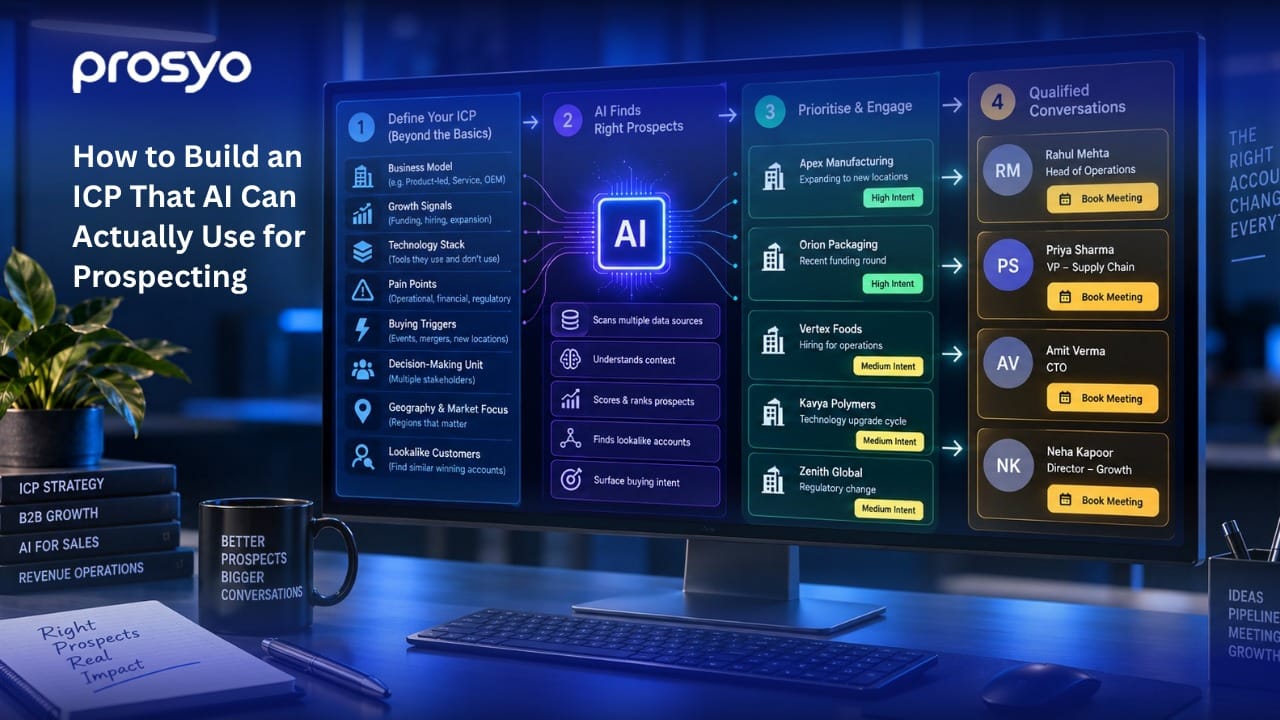
Building an Ideal Customer Profile is easy when it is just a document. The real challenge is creating an ICP that AI can actually use to find, qualify, personalize, and prioritize prospects.
A useful ICP for AI prospecting needs more than an industry, company size, and job title. It should define who is most likely to buy, what business problems they have, what signals show buying intent, and which prospects should be contacted first.
For modern sales teams, this makes the difference between generic automated outreach and relevant, context-driven prospecting.
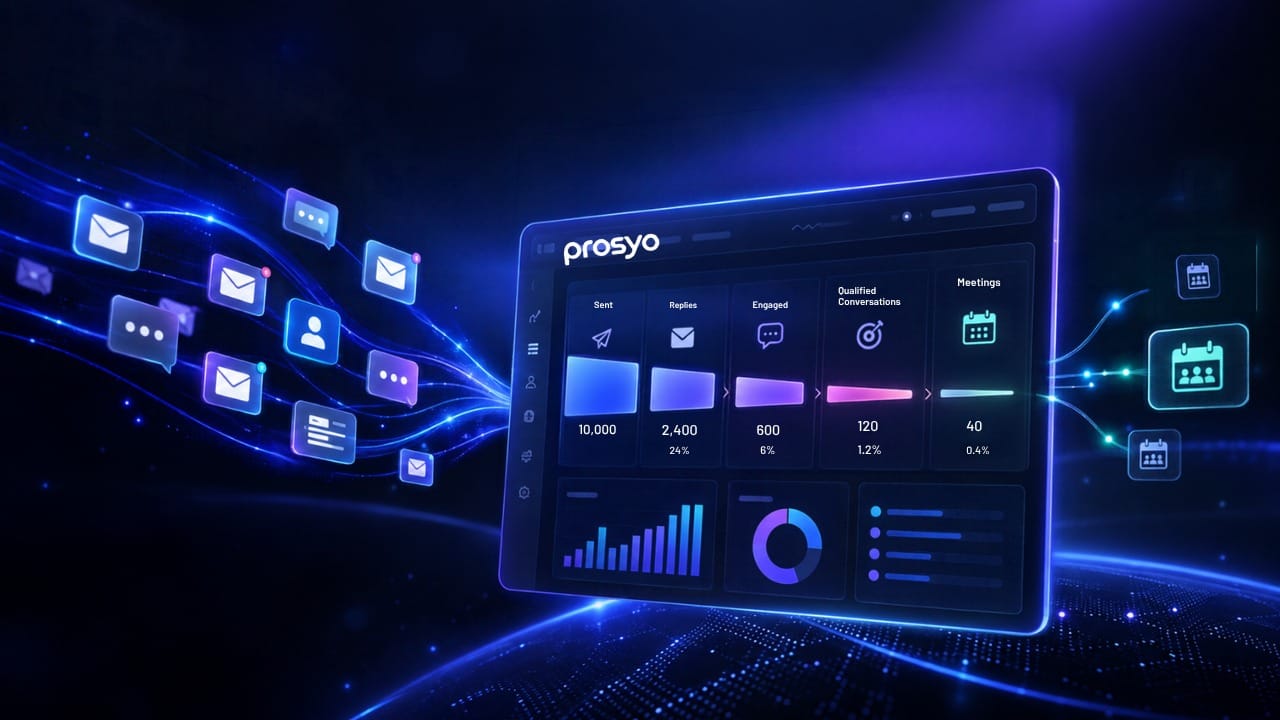
Prosyo helps sales teams connect prospect discovery, enrichment, intent, AI personalization, LinkedIn and email outreach, replies, and pipeline management in one outbound workflow. It can also work with ChatGPT and Claude through MCP, allowing teams to use natural-language instructions for prospect research, campaign preparation, personalization, and outbound workflows.
An Ideal Customer Profile, or ICP, is a detailed description of the type of company and decision-maker that is most relevant to your product or service.
An ICP for AI prospecting is structured so that an AI system can use it as a set of practical targeting rules.
Instead of saying:
“Target B2B SaaS companies.”
A more useful ICP might say:
“Target B2B SaaS companies with 50 to 500 employees, growing sales teams, an active outbound motion, and sales leaders responsible for pipeline generation. Prioritize companies showing hiring, expansion, technology, or engagement signals that indicate a potential need for better prospecting.”
This gives AI more useful information for prospect discovery and qualification.
An effective AI-ready ICP should include:
The goal is to turn your ICP from a static marketing document into a practical prospecting framework.
Many companies create an ICP once and rarely update it.
The problem is that AI needs specific and usable information. A broad ICP can result in too many irrelevant prospects, weak personalization, and inefficient outreach.
For example, an ICP that only says “marketing agencies in the United States” gives AI very little information about which companies should receive priority.
A stronger ICP could specify company size, services, growth stage, decision-maker, technology, business challenge, recent trigger, and buying intent.
A weak ICP usually has one or more of these problems:
AI prospecting works better when these gaps are removed.
Building an AI-ready ICP does not need to be complicated. Follow a structured process.
Start with the customer’s problem rather than your product.
Ask:
For example, if your product helps sales teams improve outbound prospecting, your ICP should identify companies that actually have an outbound sales problem.
This is more useful than simply targeting companies based on industry.
Look at your existing customers and identify patterns.
Review:
The purpose is to discover what your best customers have in common.
Do not assume that every company in the same industry is equally valuable.
Your ICP should identify the people who influence or control the purchase.
Depending on your offer, this may include:
Do not rely on job title alone.
AI can use job title together with company context, seniority, department, business activity, and other available signals to create a more relevant prospecting strategy.
Buying signals make an ICP much more useful for AI prospecting.
A buying signal is an event or behavior that suggests a company may have a current business need.
Examples include:
Prosyo’s platform supports prospect targeting around ICP, target accounts, industries, titles, markets, and buying signals, while its behavior-based personalization uses prospect, company, and campaign context.
A good ICP does not only tell AI who to find. It also tells AI who to avoid.
Create clear exclusion rules such as:
This helps reduce wasted prospecting activity.
Turn your ICP into measurable qualification criteria.
For example:
| ICP Factor | High-Fit Signal | Low-Fit Signal |
|---|---|---|
| Industry | Target industry | Unrelated industry |
| Company size | Matches target range | Far below target |
| Decision-maker | Relevant senior role | Unrelated role |
| Business problem | Clear pain point | No identified problem |
| Buying signal | Recent relevant trigger | No visible trigger |
| Market | Target geography | Outside service area |
| Technology | Required technology | Incompatible technology |
| Engagement | Relevant activity | No engagement |
This framework gives AI a clearer way to evaluate prospects rather than treating every lead equally.
AI needs context.
The more clearly your ICP explains why someone is a good prospect, the more useful it becomes for prospect research and personalization.
Avoid vague statements such as:
“Target growing companies.”
Use measurable descriptions such as:
“Target companies with 50 to 500 employees that are actively hiring sales representatives and expanding their outbound sales function.”
Specific criteria are easier to apply consistently.
Firmographic data describes the company.
Examples include:
Behavioral data describes what the company or prospect is doing.
Examples include:
Combining both creates a stronger prospecting model.
Your ICP should also explain what information can be used to create relevant outreach.
For example:
“Prioritize prospects that recently expanded their sales team. Reference the expansion when explaining how the solution can support outbound pipeline generation.”
This creates a clear connection between prospect research and messaging.
Prosyo is designed around context-aware personalization rather than simply inserting a prospect’s first name into a standard template. Its platform can use prospect, company, and campaign context to support personalized comments, connection requests, messages, and follow-ups.
The main difference is how the ICP is used.
| Area | Traditional ICP | AI-Ready ICP |
|---|---|---|
| Purpose | Describe ideal customers | Find and prioritize prospects |
| Data | Mostly firmographic | Firmographic plus behavioral |
| Targeting | Broad segments | Specific qualification rules |
| Buying signals | Often missing | Clearly defined |
| Personalization | Manual | Context-driven |
| Updates | Occasional | Continuously improved |
| Prospect qualification | Sales-led | AI-assisted and sales-reviewed |
| Outreach | Separate process | Connected to targeting and campaigns |
An AI-ready ICP should therefore be treated as an operating framework rather than a one-time marketing document.
Once your ICP is defined, connect it to your prospecting process.
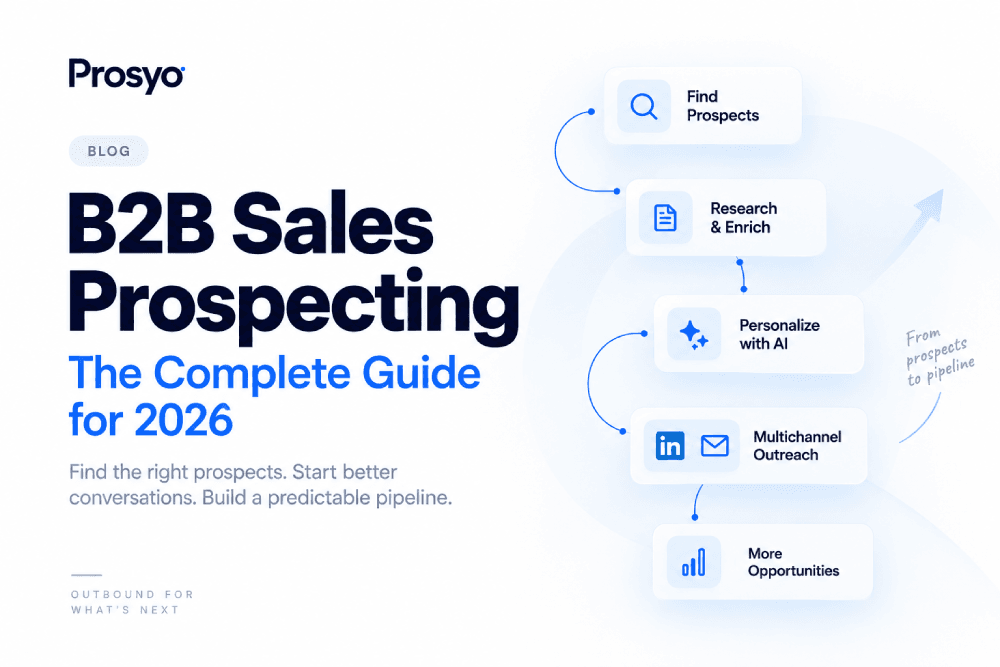
A practical workflow is:
Give AI your industries, company sizes, locations, titles, and other firmographic requirements.
Specify the events or behaviors that should increase prospect priority.
Use the ICP to identify companies and people who match the required criteria.
Add relevant company, role, behavioral, and engagement information.
Separate high-fit prospects from prospects that only partially match your criteria.
Use real prospect and company context instead of generic messaging.
Coordinate LinkedIn and email touches according to your campaign strategy.
Analyze replies and identify prospects showing interest.
Connect interested conversations with meetings and pipeline activity.
Prosyo combines prospect discovery, enrichment, intent, AI personalization, LinkedIn and email sequences, reply management, and analytics within one outbound workflow. It also supports working through ChatGPT and Claude using MCP.
Your first ICP will not be perfect.
Treat it as a working system that improves as you collect campaign data.
Review:
Use these findings to update your ICP.
This creates a feedback loop:
ICP → Prospecting → Outreach → Replies → Qualification → Pipeline → ICP Improvement
The result is a more focused and useful prospecting system.
Avoid these mistakes when creating an ICP for AI prospecting:
Human review remains important. Prosyo specifically emphasizes human control so teams can review important targeting, copy, and campaign decisions before outbound activity represents their brand.
You can use this structure to create an ICP for your next outbound campaign.
Ideal Customer:
Describe the company you want to reach.
Industry:
List your target industries.
Company Size:
Define the employee or revenue range.
Geography:
Specify target countries, regions, or cities.
Business Model:
Describe the types of companies you want.
Decision-Makers:
List relevant departments, job titles, and seniority.
Business Problems:
Identify the problems your product solves.
Buying Signals:
List events and behaviors that indicate potential demand.
Technology Signals:
Identify relevant technologies or platforms.
Exclusions:
List companies or prospects that should not be targeted.
Personalization Context:
Define what information AI should use when creating outreach.
Qualification Rules:
Explain what makes a prospect high-fit, medium-fit, or low-fit.
This format gives AI enough context to support prospect discovery, qualification, personalization, and campaign execution.
An ICP, or Ideal Customer Profile, describes the type of company that is most likely to benefit from and purchase your product or service. It typically includes industry, company size, geography, business model, decision-makers, problems, and buying signals.
An AI-ready ICP contains specific and structured information that AI can use to find, qualify, prioritize, and personalize prospects. It should include both company characteristics and behavioral or buying signals.
AI can help analyze customer data and identify common patterns, but the ICP should be reviewed by the sales and marketing team. Human input is important for defining business priorities, exclusions, qualification rules, and messaging.
An ICP can include industry, company size, geography, revenue, business model, technology, job titles, seniority, business problems, buying signals, engagement behavior, and exclusion criteria.
AI can use ICP criteria to identify matching accounts, research prospects, prioritize opportunities, identify relevant context, and support personalized outreach.
Yes. Buying intent can help distinguish companies that simply match your firmographic criteria from companies that may have a current or emerging need.
Review your ICP regularly using prospecting, reply, meeting, conversion, and pipeline data. The frequency depends on how quickly your market and customer base change.
Yes. A detailed ICP gives AI more context about who the prospect is, what problems they may have, and why your offer may be relevant. This can support more contextual messaging than generic personalization.
A useful ICP for AI prospecting is more than a list of industries, company sizes, and job titles. It is a structured set of targeting, qualification, behavioral, and buying-signal rules that helps AI understand which prospects matter and why.
Start with your best customers. Identify common characteristics. Define the decision-makers. Add business problems and buying signals. Create exclusion rules. Then connect the ICP to prospect discovery, personalization, LinkedIn and email outreach, replies, and pipeline measurement.
The goal is not simply to automate more prospecting. The goal is to make prospecting more relevant.
With an AI-ready ICP and a connected outbound workflow, teams can spend less time searching through irrelevant prospects and more time engaging with companies that match their actual sales strategy.
Prosyo brings prospect discovery, enrichment, intent, AI personalization, LinkedIn and email outreach, replies, and pipeline activity into one connected outbound system, with support for AI workflows through ChatGPT and Claude using MCP.
For teams building an AI-native outbound motion, the first step is simple: define exactly who you want to reach, why they are a fit, and what signals indicate that the timing may be right.