AI Sales
September 24, 2026
15 min read




AI SDR is one of the most overloaded terms in B2B sales right now. In some products it means an email writer. In others it means a prospecting bot, an autonomous campaign builder, a reply assistant or a full outbound workflow.
The useful question is not whether an AI SDR can “replace” a salesperson. The useful question is which parts of outbound can be delegated to software without damaging targeting, judgment or the buyer experience.
When that line is drawn well, AI can remove hours of campaign preparation and repetitive execution. When it is drawn badly, a team simply sends more low-quality outreach at higher speed.
An AI SDR is software that uses artificial intelligence to perform or assist with sales development tasks such as identifying prospects, researching accounts, generating personalized messages, building sequences, coordinating outreach, classifying replies and helping move qualified conversations toward meetings.
The strongest AI SDR systems are not single-purpose copy generators. They connect the steps around the message: who to target, why they are relevant, what to say, which channel to use, what happens next and when a human should take over.
Manual research is valuable but expensive. AI can summarize company positioning, role context, public signals and likely pain points much faster than a rep can open ten tabs for every prospect.
The output should be structured enough to influence the campaign: ICP fit, reason to contact, likely use case and relevant proof point.
Building a sequence step by step is repetitive. A modern AI sales system should let a user describe the audience, offer and objective in plain language, then generate a sensible campaign structure with LinkedIn and email touches, delays, message variants and follow-ups.
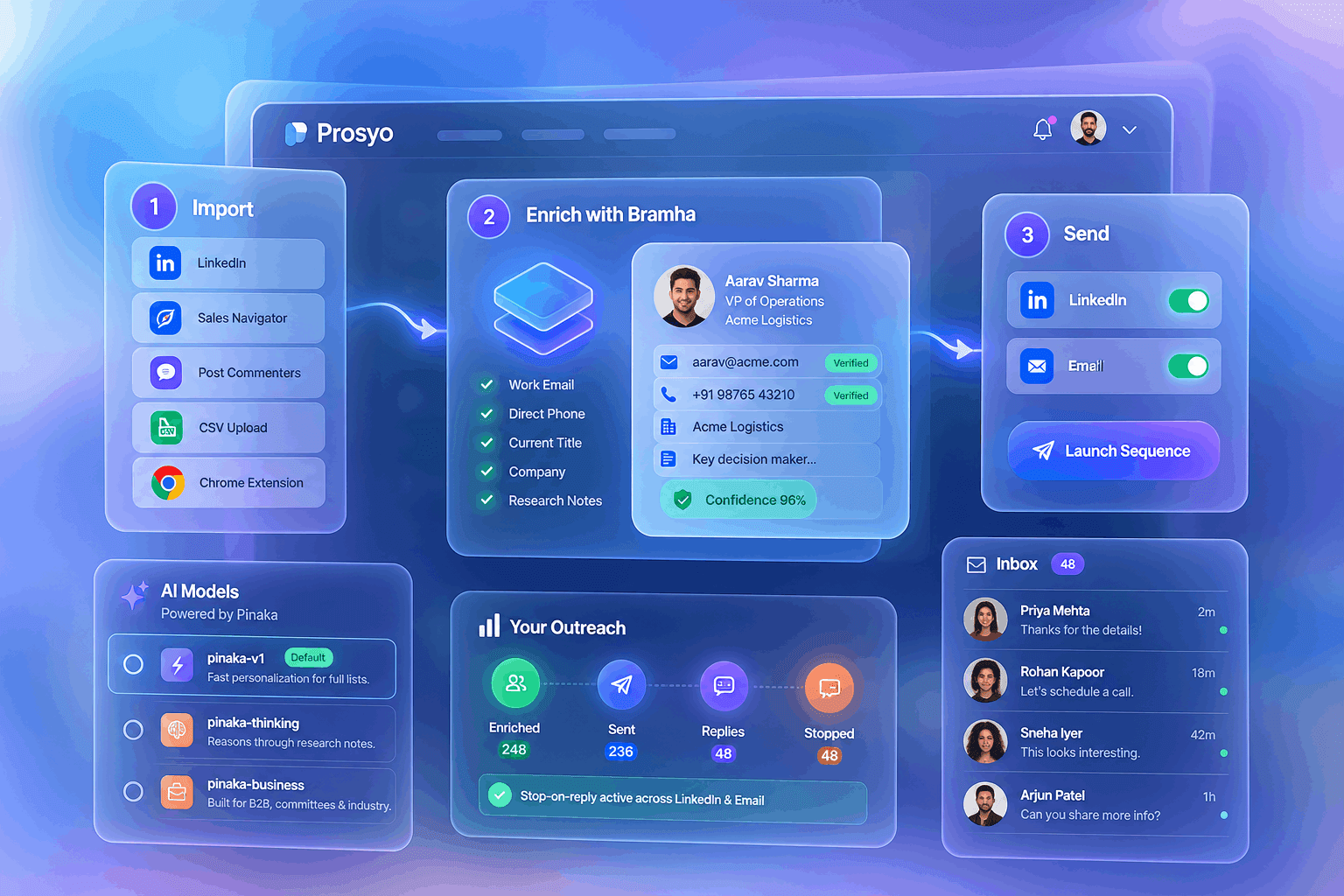
This is where Prosyo’s one-click campaign generation is useful: it turns a conversational brief into a starting outbound workflow instead of forcing the rep to configure every step manually.
AI is well suited to turning known prospect context into relevant message angles. The key is grounding. A good first liner connects a real observation to the business problem; it does not invent enthusiasm about a random social post.
Prosyo combines AI icebreakers with AI personalization so the first line, body and follow-up can be generated from the same campaign context.
Once a campaign has been reviewed, software can handle delays, channel transitions, follow-up timing and repeatable outreach steps. This is particularly useful in a multichannel outreach motion where LinkedIn and email need to stay coordinated.
AI can help distinguish positive interest, objection, referral, out-of-office, unsubscribe requests and irrelevant replies. That makes the inbox easier to triage and helps teams prioritize conversations with real intent.
AI can propose a target segment, but leadership still needs to decide which market is worth pursuing and why the product is credible there.
Once a prospect asks a serious question about pricing, implementation, security, timing or fit, a human should own the conversation. AI can draft a response, but the seller should understand the context and approve the message.
Objection handling depends on nuance. A prospect saying “not interested” is different from “we already use a competitor,” “circle back next quarter,” or “send this to our RevOps lead.” Those responses should change both the next action and the opportunity strategy.
If a campaign consistently underperforms, the answer is not always better copy. The ICP, offer, proof or commercial model may need to change. That is a business decision, not a sequence optimization.
Traditional sales automation follows predefined rules. If step one happens, wait three days and send step two. AI adds interpretation and generation.
That difference matters in three places:
The best systems combine deterministic workflow logic with AI where interpretation is useful. You do not need an AI model to decide that a five-day delay lasts five days. You do need one to understand whether a reply is a genuine buying signal.
Specify the account attributes and buyer roles that make a prospect valuable. Avoid broad categories such as “B2B companies.” Narrower segments produce better data, messages and conversion analysis.
Good outbound has a reason. That may be hiring, a go-to-market change, a new market, a visible process problem, a technology signal or simply a strong fit with a tightly defined use case.
Decide what the first touch needs to accomplish, what proof the next touch adds and what the CTA should be. Then let AI generate variants inside that structure.
Do not let the channels behave like separate campaigns. A LinkedIn reply should stop the email follow-up. An email response should change the LinkedIn sequence. Prosyo’s sequences are built around that connected state.
The moment someone responds, the workflow should shift from outbound automation to conversation management. A unified inbox keeps LinkedIn and email replies visible without forcing sellers to jump between tabs.
The success metric for an AI SDR is not how many messages it can write. Measure positive replies, meetings, qualified opportunities, pipeline value and conversion by segment.
For some highly transactional tasks, AI can remove a large portion of manual SDR work. It can research accounts, prepare messages, launch sequences, surface replies and keep data organized.
But replacement is the wrong design target for most B2B teams. The better target is leverage: one seller or small team can run a more disciplined outbound motion without spending most of the day on list cleanup, research tabs and sequence configuration.
That matters especially for founder-led sales teams, agencies and lean B2B companies that need outbound before they are ready to hire a full SDR organization.
Not every company wants to operate the system internally.
AI SDR software makes sense when your team already understands the offer and ICP and wants control over targeting, messages and conversations.
A managed AI SDR or ABM service makes more sense when you want the research, account strategy, campaign operation, personalization and qualification handled for you.
Prosyo supports both models. Teams can use the platform directly, or use Managed ABM + AI SDR for a more hands-on outbound program.
A long feature list matters less than whether the workflow reduces the distance between an ICP idea and a qualified conversation.
AI SDRs are most valuable when they automate preparation and repetition while preserving human control over strategy and conversation. Use AI to research faster, generate better starting points, personalize at scale and keep campaigns coordinated. Do not use it as an excuse to send indiscriminate outreach.
Prosyo brings prospecting, one-click campaign generation, personalized LinkedIn + email sequences, AI first liners and reply management into one workspace. Explore Prosyo, compare pricing, or learn about the managed AI SDR service.