Marketing Automation
September 16, 2026
10 min read



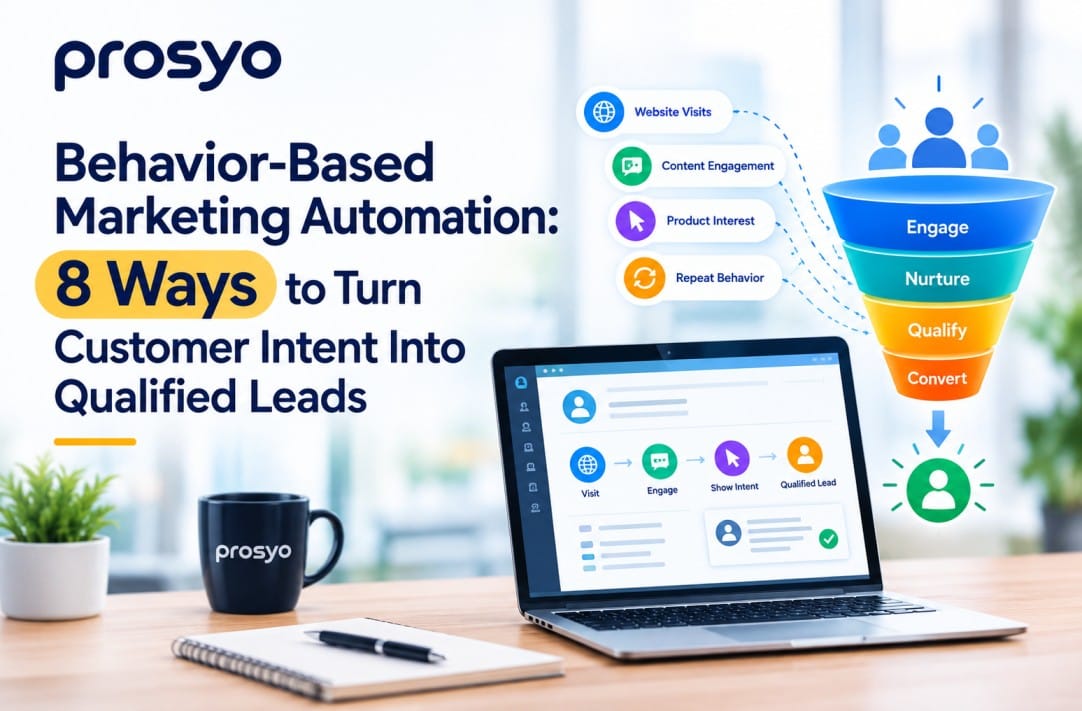
Most businesses do not struggle because they lack leads. They struggle because they cannot identify which leads are genuinely interested, what those prospects need, or when they are ready to talk to sales.
A person who downloads an ebook is not necessarily as valuable as someone who visits a pricing page three times, compares solutions, and requests a product demonstration. Both are leads, but their intent is different.
This is where behavior-based marketing automation becomes valuable. Instead of treating every prospect the same, it uses customer actions to understand interest, personalize communication, and identify buying opportunities. With the right marketing automation tools, businesses can turn customer behavior into meaningful engagement and qualified leads.
For companies investing in sales and marketing automation, the goal is not simply to send more emails or collect more contacts. The goal is to understand customer intent and help sales teams focus on prospects who are most likely to convert.
Behavior-based marketing automation is a marketing approach that uses a prospect’s actions, interactions, and engagement patterns to trigger relevant marketing activities.
These actions may include visiting a website, downloading content, opening an email, clicking a product link, watching a video, requesting a demo, or returning to a pricing page.
Unlike traditional automation, which often sends the same message to every contact, behavior-based automation responds to what each prospect actually does.
For example:
This approach helps businesses deliver the right message at the right stage of the buyer journey.
Customer intent shows how likely a prospect is to take a meaningful action, such as requesting a consultation, booking a demo, or making a purchase.
Not every interaction indicates the same level of interest. A social media click may show curiosity, while a pricing request may indicate strong buying intent.
Understanding these differences helps businesses:
When marketing automation software captures and interprets these signals, businesses can move from simply generating leads to identifying leads with genuine commercial potential.
Website activity is one of the clearest sources of customer intent. The pages a prospect visits, the time they spend on a page, and the actions they take can reveal their interests.
For example, someone reading a general blog post may still be researching a problem. However, someone visiting a pricing page, service comparison page, or product features page may be closer to making a decision.
Marketing automation tools can help businesses monitor important behavioral signals, such as:
Businesses can then create automated workflows based on these actions. A prospect who visits a pricing page may receive a case study, product guide, or invitation to speak with a specialist.
The key is to use website behavior as a signal of interest, not as an automatic guarantee that someone is ready to buy.
Lead scoring assigns values to prospect actions and characteristics to estimate their level of interest and sales readiness.
For example, a business might assign points for:
A prospect who only downloads one general guide may receive a lower score. A prospect who downloads a case study, visits the pricing page, and requests a consultation may receive a higher score.
A basic lead scoring process can follow these steps:
Lead scoring works best when it combines behavior with business fit. A highly engaged person who cannot use the product may not be as valuable as a decision-maker from the right industry.
Generic messages often fail because they do not address the prospect’s current needs. Behavior-based automation allows businesses to personalize content according to previous interactions.
For example, a visitor interested in enterprise solutions should not receive the same follow-up as someone researching basic features.
Personalization can be based on:
A prospect who reads an article about implementation challenges may receive a guide explaining deployment, while someone exploring pricing may receive a return-on-investment resource.
Effective personalization does not require guessing everything about a customer. It simply uses available information to make communication more relevant and useful.
Many prospects are interested but are not ready to buy immediately. If businesses contact them too aggressively, they may lose interest. If they do nothing, the opportunity may disappear.
Automated lead nurturing helps maintain relationships by delivering useful content over time.
A nurturing workflow can be divided into different intent levels:
For example, a prospect who downloads an introductory guide may receive a series of educational emails. If that prospect later visits a product page, the workflow can shift toward more specific information.
This is an important part of sales and marketing automation because it allows marketing teams to support prospects until they show stronger buying signals.
Timing can significantly influence lead conversion. A follow-up sent several days after a high-intent action may be less effective than one delivered while the prospect is actively engaged.
Marketing automation software can trigger follow-up actions when a prospect:
For example, when someone requests a demo, the system can send a confirmation email, notify the sales representative, and create a follow-up task in the CRM.
However, automation should not become intrusive. Businesses should set reasonable frequency limits and ensure that messages provide value rather than simply repeating sales pitches.
Segmentation divides leads into groups based on shared characteristics or behaviors. It helps businesses avoid sending identical messages to audiences with different needs.
Useful segmentation categories include:
For example, a software company may create separate segments for startup founders, enterprise decision-makers, and technical managers. Each group can receive content that addresses its specific challenges.
Behavior-based segmentation becomes more powerful when it changes dynamically. If a prospect moves from reading educational content to requesting a consultation, the system can update the segment and adjust future communication.
This improves relevance and helps sales teams understand what each lead is interested in.
Marketing automation becomes much more effective when marketing and sales systems work together.
Without integration, marketing teams may generate leads that sales representatives cannot easily understand or follow up with. CRM integration helps transfer important information, such as lead source, engagement history, lead score, and recent activities.
A connected workflow may look like this:
This process gives sales teams useful context before starting a conversation.
For successful sales and marketing automation, businesses should define clear rules for when a lead moves from marketing to sales. Both teams should agree on what makes a lead qualified.
Not every lead converts during the first campaign. Some prospects become inactive because their priorities change, they need more information, or the timing is not right.
Instead of removing these contacts immediately, businesses can use re-engagement automation to identify whether interest has returned.
Re-engagement triggers may include:
A re-engagement campaign might offer a useful industry update, a new resource, a product improvement announcement, or an invitation to discuss current needs.
The objective is not to repeatedly chase inactive contacts. It is to recognize renewed interest and provide a relevant next step.
A successful workflow requires more than choosing marketing automation tools. Businesses need a clear process that connects customer behavior to useful actions.
Start by identifying who your ideal customers are and what you want automation to achieve. Your goal may be to increase demo requests, improve lead quality, shorten response time, or increase qualified sales opportunities.
List the actions that indicate interest in your products or services. These may include pricing page visits, content downloads, form submissions, webinar attendance, or product comparisons.
Create content for different stages of the buying process. Educational content supports early research, while case studies, product details, and consultations support evaluation.
Define what should happen after each action. For example, a content download may trigger an educational email, while a demo request may create a sales notification.
Ensure that customer interactions, lead scores, and contact details are shared between marketing and sales systems. This reduces data gaps and improves follow-up.
Track metrics such as marketing-qualified leads, sales-qualified leads, conversion rates, email engagement, and revenue influenced by marketing. Use these results to improve your automation strategy.
Behavior-based automation helps businesses improve both marketing efficiency and customer experience.
Key benefits include:
The results depend on data quality, workflow design, content relevance, and regular optimization. Automation is most effective when it supports a well-defined marketing and sales process.
Behavior-based marketing automation uses customer actions, such as website visits, email clicks, content downloads, and demo requests, to trigger personalized marketing activities and identify buying intent.
Marketing automation helps qualify leads by tracking engagement, assigning lead scores, identifying high-intent actions, and routing suitable prospects to sales teams based on predefined criteria.
The right tools depend on business requirements. Businesses should look for platforms that support behavioral tracking, lead scoring, email automation, CRM integration, segmentation, reporting, and workflow customization.
Yes. Small businesses can use marketing automation software to automate repetitive tasks, nurture leads, personalize communication, and improve follow-up. Starting with a few focused workflows is often more effective than building complex automation immediately.
Businesses can avoid intrusive automation by using permission-based communication, limiting message frequency, providing useful content, respecting customer preferences, and triggering messages based on meaningful actions rather than every minor interaction.
Behavior-based marketing automation helps businesses move beyond generic campaigns and understand what prospects actually need. By tracking website behavior, using lead scoring, personalizing content, nurturing prospects, and connecting marketing with sales, companies can identify stronger opportunities and improve the customer journey.
The right marketing automation tools do more than automate emails. They help businesses turn customer signals into timely, relevant, and measurable actions.
For companies looking to improve lead generation, sales and marketing automation provides a practical way to connect customer intent with business growth. Start with a few high-value behaviors, build focused workflows, and continuously improve them using real performance data.
When automation is guided by customer intent, businesses can spend less time searching for opportunities and more time engaging with the prospects most likely to become customers.
About Prosyo: Prosyo helps businesses improve their lead generation and marketing processes through strategies designed to identify customer intent, connect with relevant prospects, and support better conversion opportunities.